In this guide
Three Separate Jobs, Three Separate Fixtures
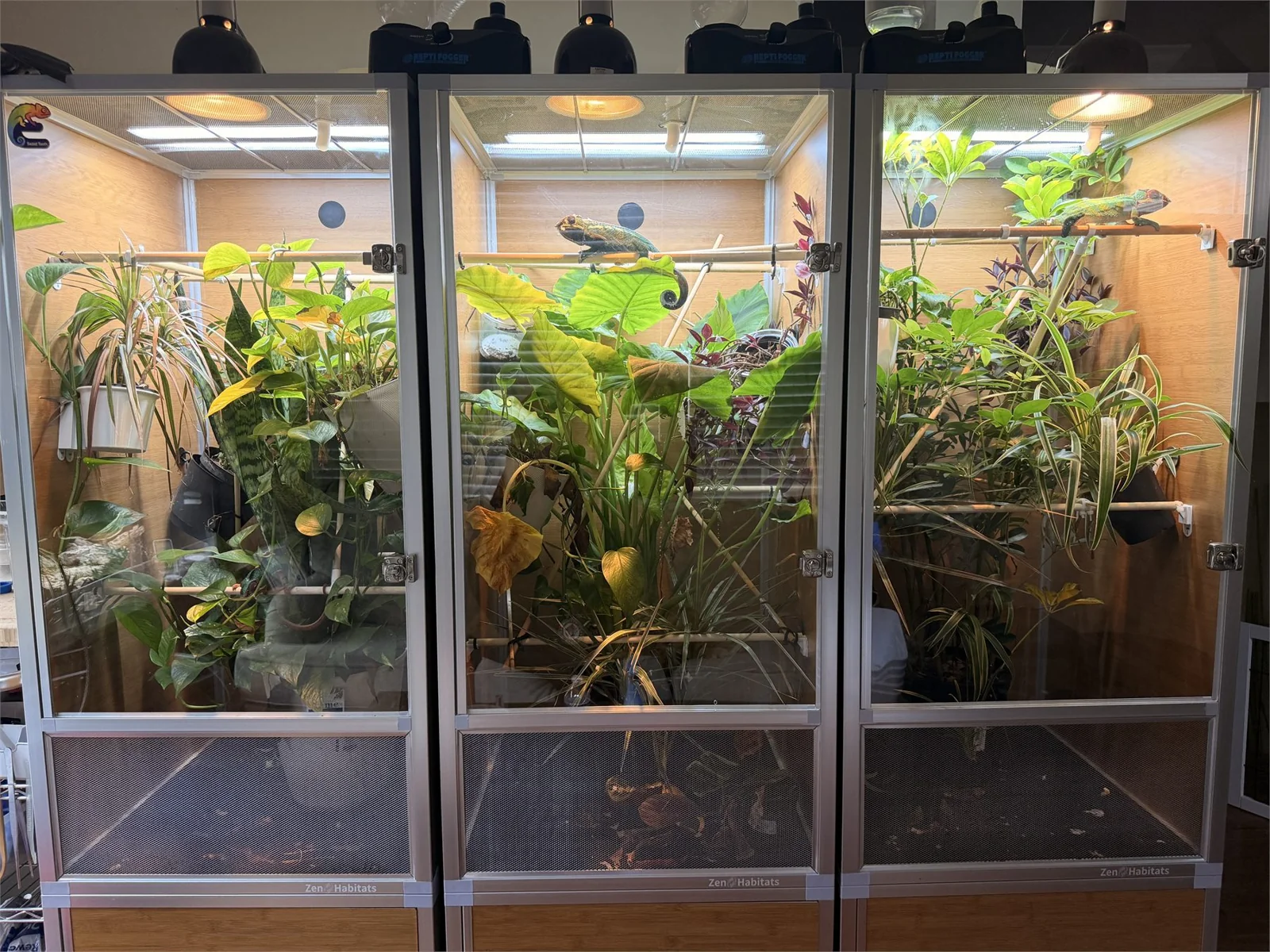
Almost every lighting mistake comes from expecting one bulb to do more than one job. There are three distinct requirements and they do not overlap:
UVB
so your chameleon can synthesize vitamin D3 and use calcium
Heat
a basking spot to raise body temperature and drive digestion
Visible light for plants
so your live planting survives
A UVB bulb produces almost no useful heat. A basking bulb produces essentially no UVB. A plant grow light produces neither meaningful UVB nor basking heat. You need all three.
UVB
Without UVB, a chameleon cannot produce vitamin D3, cannot absorb dietary calcium, and will develop metabolic bone disease. This is not optional and it is not something supplements alone can fix reliably.
Use a Linear T5 HO Fixture
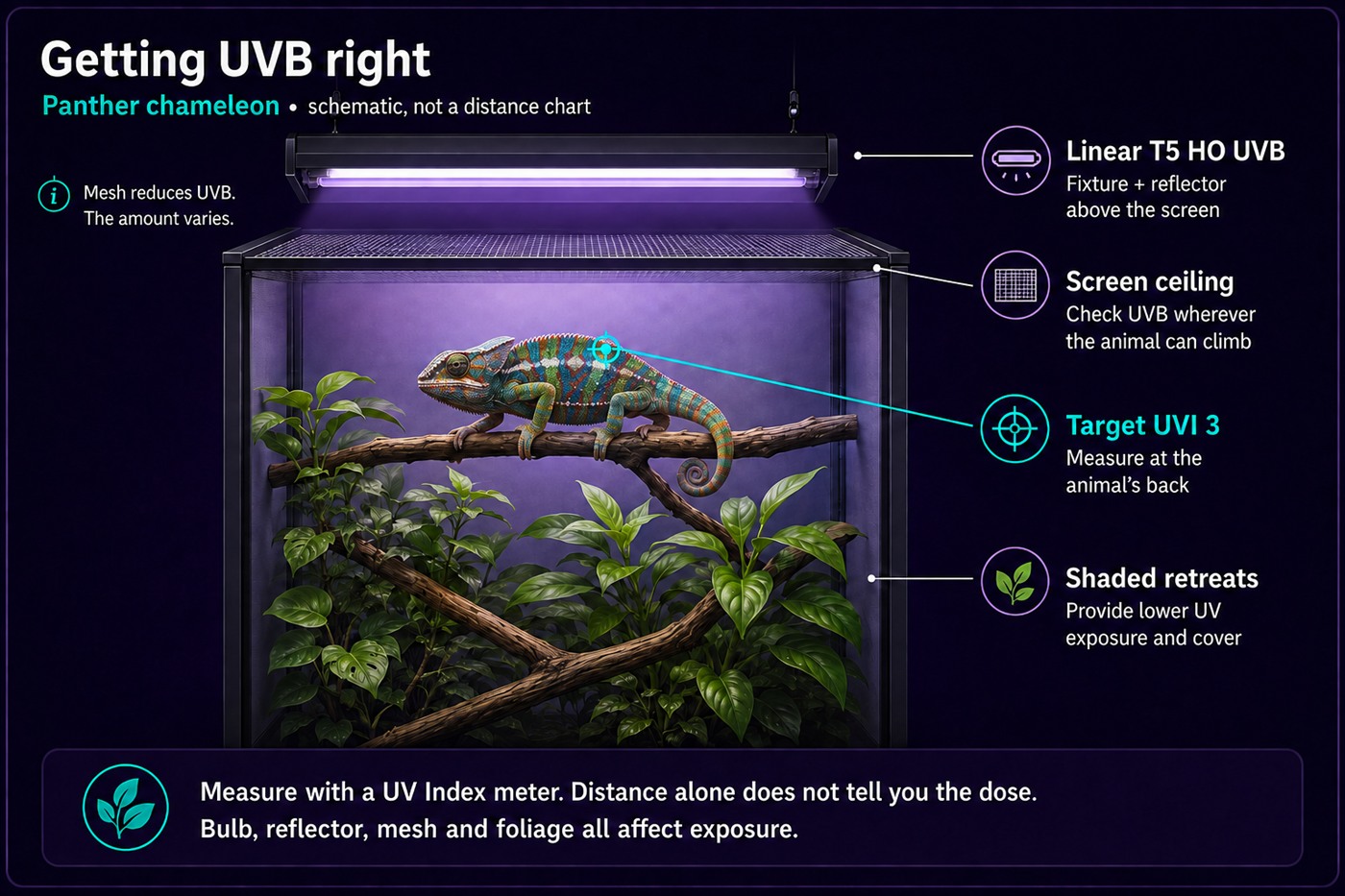
A linear T5 High Output tube, running most of the width of the enclosure. This gives a broad band of usable UV rather than a single intense point, so your chameleon can choose its own exposure by moving.
Do not use compact or coil UVB bulbs. They produce a narrow, intense column of UV directly beneath them, and older designs have a documented history of causing eye damage. There is no reason to use one.
Aim for UVI 3, and Measure It
The number that matters is the UV Index on your chameleon's back while it is perched in its basking spot, not the percentage printed on the box. Target UVI 3 there, and make sure there is genuine shade elsewhere in the enclosure so the animal can choose less.
Then measure the places it can reach, not just the place it should sit. That is the step people skip, and it is the one that matters if your fixture sits on the screen.
| Mounting | How it works | What to watch |
|---|---|---|
| Fixture resting on the screen top | Simplest. Set the basking branch at whatever distance reads UVI 3 at the animal's back. | The screen is now right against the tube. A chameleon that climbs the ceiling gets a dose far higher than anything you measured at the basking spot. Either make sure it cannot perch up there, or raise the fixture. |
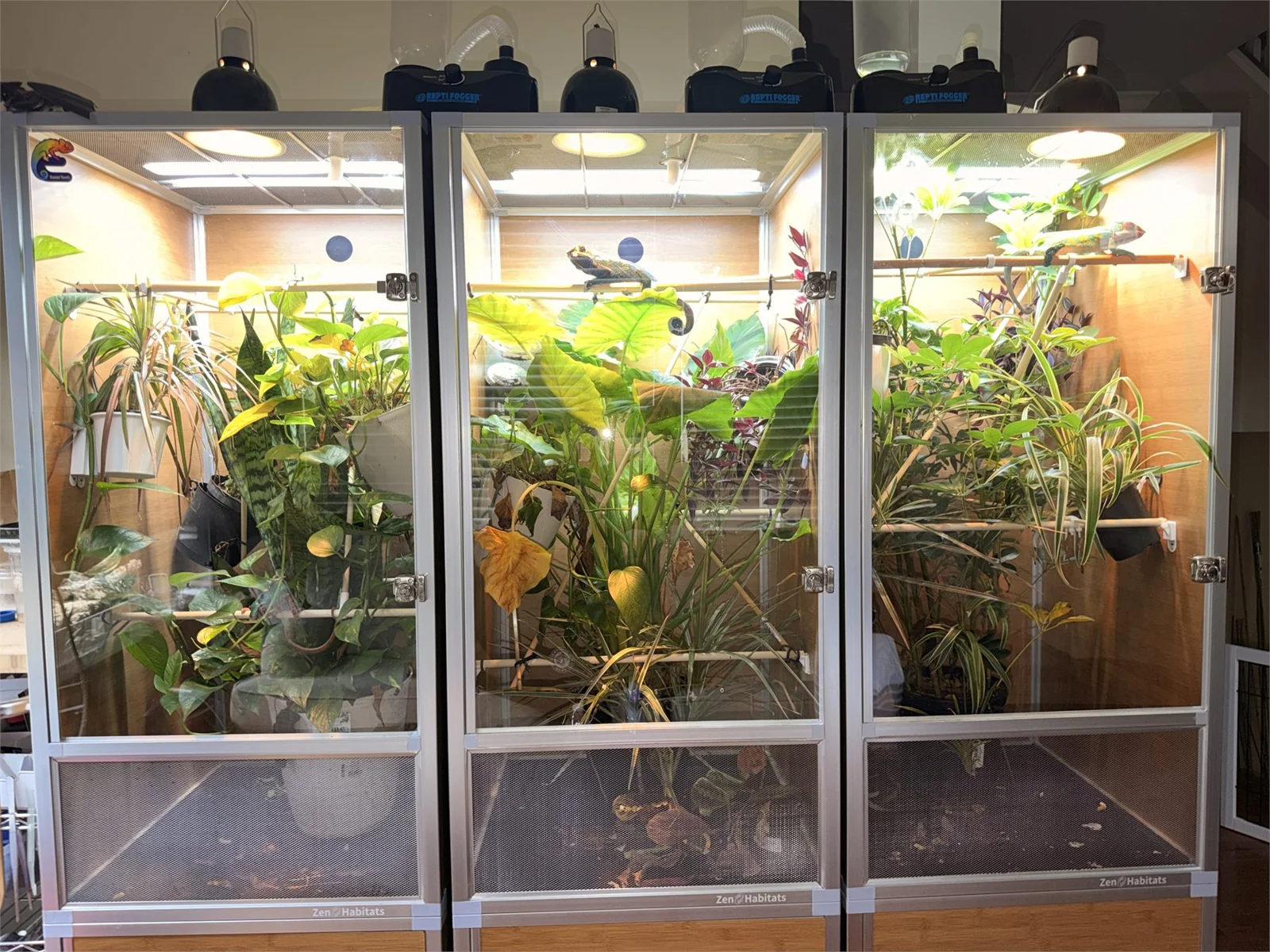
| Fixture suspended above the screen | A deliberate gap between tube and screen, which is how our rack system is built. | Still measure at the back, not at the branch surface. |
We run both setups here. What stays constant is the reading at the animal's back, not the distance. There is no distance that works in the abstract: what actually reaches your chameleon depends on the bulb, whether the fixture has a reflector, the mesh in between, and how far its back sits from the tube. Change any one of those and the number changes, which is why we are not quoting you inches.
A Solarmeter 6.5 is the only way to know. If you keep chameleons long term it is worth the money; if you cannot justify one, ask someone in a local group who has one. Directly under the tube at the screen you should see something around UVI 6, falling away to roughly UVI 1 lower down. That gradient is the point, and it is what lets the animal self-regulate.
Replace Bulbs on Schedule
UVB output falls long before the tube stops producing visible light. A bulb that looks perfectly bright can be producing almost no usable UVB. Replace T5 HO tubes every 9–12 months, and write the date on the tube in marker when you fit it.
Basking Heat
We use a 50 to 75 watt Arcadia halogen in a ceramic-socket dome fixture. There is no advantage to a colored "reptile basking" bulb.
What you want is a broad, gentle pool of warmth, not a tight hot spot. A chameleon basks with its whole body. A narrow beam heats a patch of its back while the rest of it stays cold, which does nothing for digestion and is easy to overdo. Raise the lamp and let the warm area spread until it comfortably covers the length of branch the animal actually sits on.
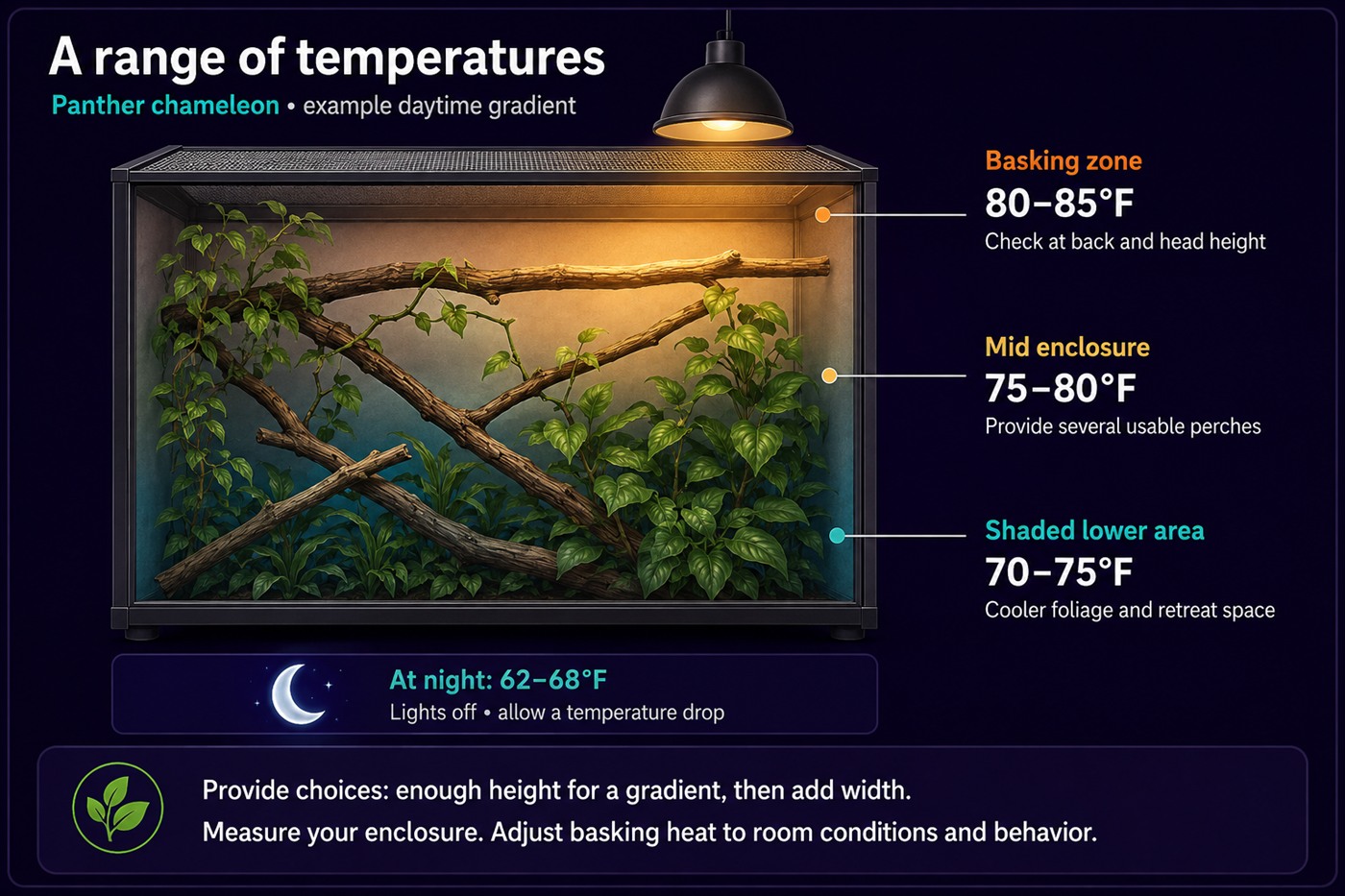
- Target 80–85 °F in the basking zone, measured at the height the animal's back and head will actually sit
- A branch-surface reading tells you about the wood. Put the probe where the body will be.
- Choose wattage to hit that temperature in your room: 50W is often enough, 75W if your house runs cold
- Put it over one corner, so the rest of the enclosure stays cooler and there is somewhere to retreat to
- 8–12 in between bulb and branch is a starting point, not a safe distance. It is where you begin measuring. It guarantees nothing about burns.
- Check what the animal can reach above the branch. If it can climb nearer the lamp than the basking spot, that is the distance that matters.
Basking heat does not need to keep the same hours as the lights. Give it its own timer and set it from behavior and room temperature. Your chameleon should warm up through the first part of the morning, then move off and get on with its day. If it is still parked under the lamp at midday, the rest of the enclosure is too cold. If it barely uses the basking spot at all, your room is already warm enough and the bulb can come on later or run shorter.
Chameleons will happily sit under a heat source until they cook. They do not reliably move away from a spot that is too hot. Verify with a thermometer, and never rely on the bulb's wattage rating as a proxy for temperature.
Never Use a Heat Rock or an Under-Tank Heater
Chameleons sense heat from above, the way the sun works. A heat source below or beside them will not trigger a move-away response, and contact burns are common and severe. Overhead heat only.
Building a Gradient
The goal is not one correct temperature. It is a range your chameleon moves through to regulate itself.
- Basking branch: 80–85 °F
- Mid enclosure: 75–80 °F
- Lower / shaded: 70–75 °F
Keep enough height to build a real gradient, then add width. Vertical distance is what creates the temperature range; width is what lets the animal move through it and pick a spot. A tall narrow box gives you the gradient and nowhere to use it. If the top and bottom of your enclosure read the same temperature, your chameleon has no choices to make.
Night-Time Temperatures
Let it get cold. A night-time drop to 62–68 °F is not something to prevent. It is beneficial, and it mirrors what happens in Madagascar every night.
No lights at night. No red bulbs, no blue "moonlight" bulbs, no ceramic heat emitters unless your room genuinely drops below the mid 50s. Chameleons need real darkness to sleep properly, and colored night bulbs disrupt that.
Plant Lighting
Your UVB tube will not keep plants alive. Add a plant light on the same timer as everything else. We use Arcadia Jungle Dawn; any decent LED grow bar or 6500K daylight LED does the job. Healthy plants mean better humidity, better cover and more drinking surfaces. It is chameleon husbandry, not decoration.
Photoperiod
12 hours on, 12 hours off, on timers, every day. That is your UVB and plant lighting; the basking bulb is a separate case and is covered above. Consistency matters more than the exact split. Some keepers shorten the day slightly through winter to mirror seasonal change; that is fine, but a stable cycle is the priority.
Put every fixture on a timer. A forgotten light left on overnight, or a basking bulb that never comes on because you were out, is easy to avoid and genuinely harmful.
Metabolic Bone Disease
MBD is what happens when a chameleon cannot get or use enough calcium. The bones soften and deform. Advanced cases are permanent, and it is the single most common serious problem in captive chameleons, and almost entirely preventable.
It is caused by some combination of:
- No UVB, inadequate UVB, or an expired bulb
- A coil bulb instead of a linear tube
- UVB firing through glass, which blocks it entirely
- Not dusting feeders with calcium
- Poorly gut loaded feeders
Early signs to watch for:
- A rubbery or bendy lower jaw
- Bowed or swollen limb bones
- Weak grip; falling off branches
- Tremors or twitching
- Reluctance to climb, or sitting on the enclosure floor
If you see any of these, get to an exotics vet quickly. Caught early, MBD can be stopped, and the animal can go on to live a normal life. What it will not do is undo itself: bone that has already deformed stays deformed. Left alone it keeps getting worse. This is why the lighting is worth getting right first time.
Common Mistakes
- Coil UVB bulbs. Use a linear T5 HO instead. Always.
- UVB through glass. Glass blocks UVB completely. Screen only, and account for the loss.
- Never replacing the bulb. Output drops long before the light dies.
- Basking bulb too close. Causes thermal burns on the casque and back.
- Heating at night. The night-time drop is good for them.
- Colored night bulbs. They disrupt sleep and serve no purpose.
- No thermometer. Guessing your basking temperature is how animals get cooked.
- Measuring the branch and stopping there. A temperature gun reads the surface of the wood. It does not tell you what the lamp is doing to the head and back of an animal sitting above it, which is where burns actually happen.
- Relying on the D3 supplement instead of UVB. Oral D3 alone is far easier to overdose and far less reliable.
Sources for This Guide
The specific articles behind the recommendations on this page. We have read them, and if you want to go further than this guide takes you, they are where to go next.
- Chameleon Cage Set Up: Replicating the Sun, Bill Strand, Chameleon Academy