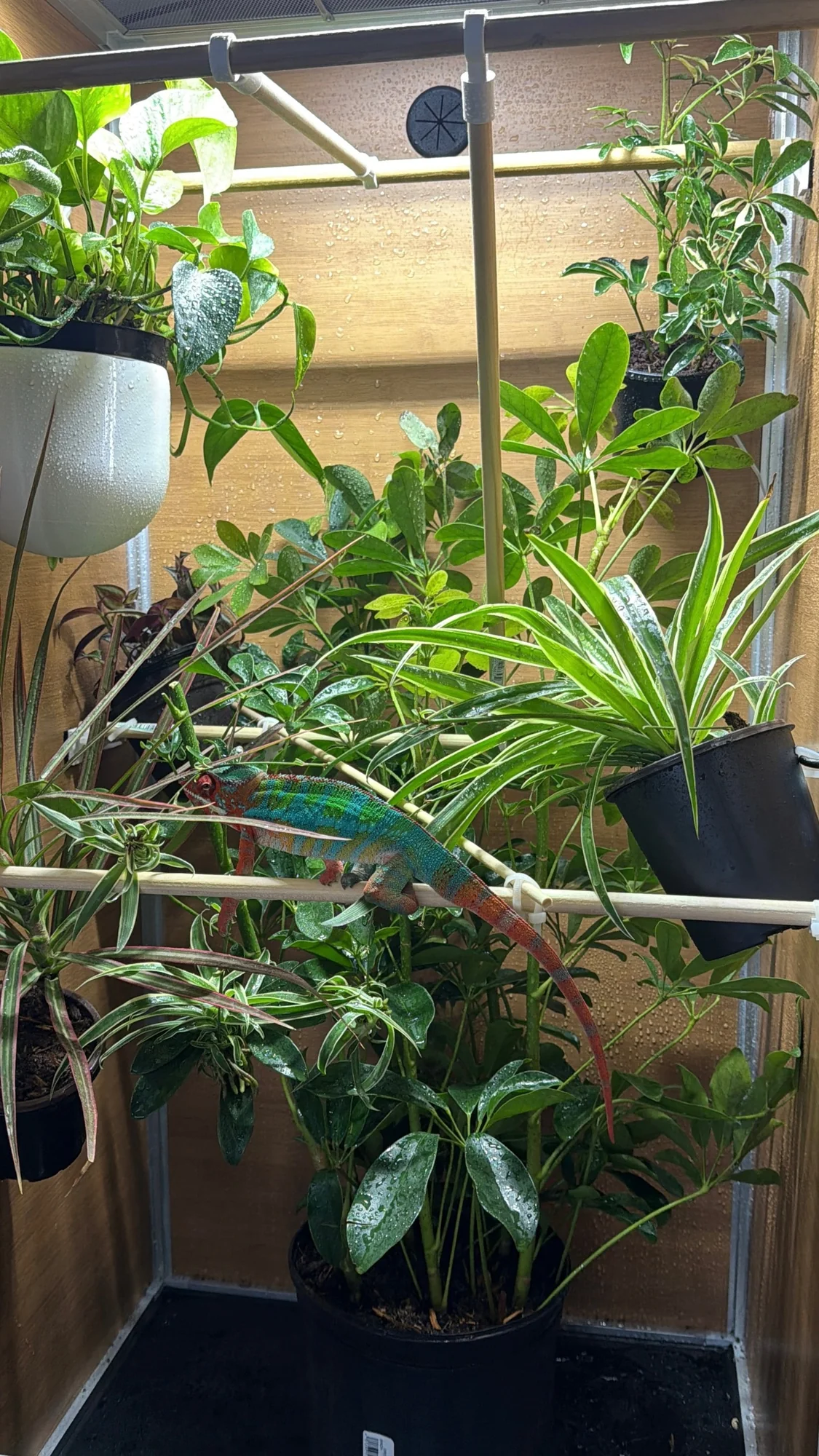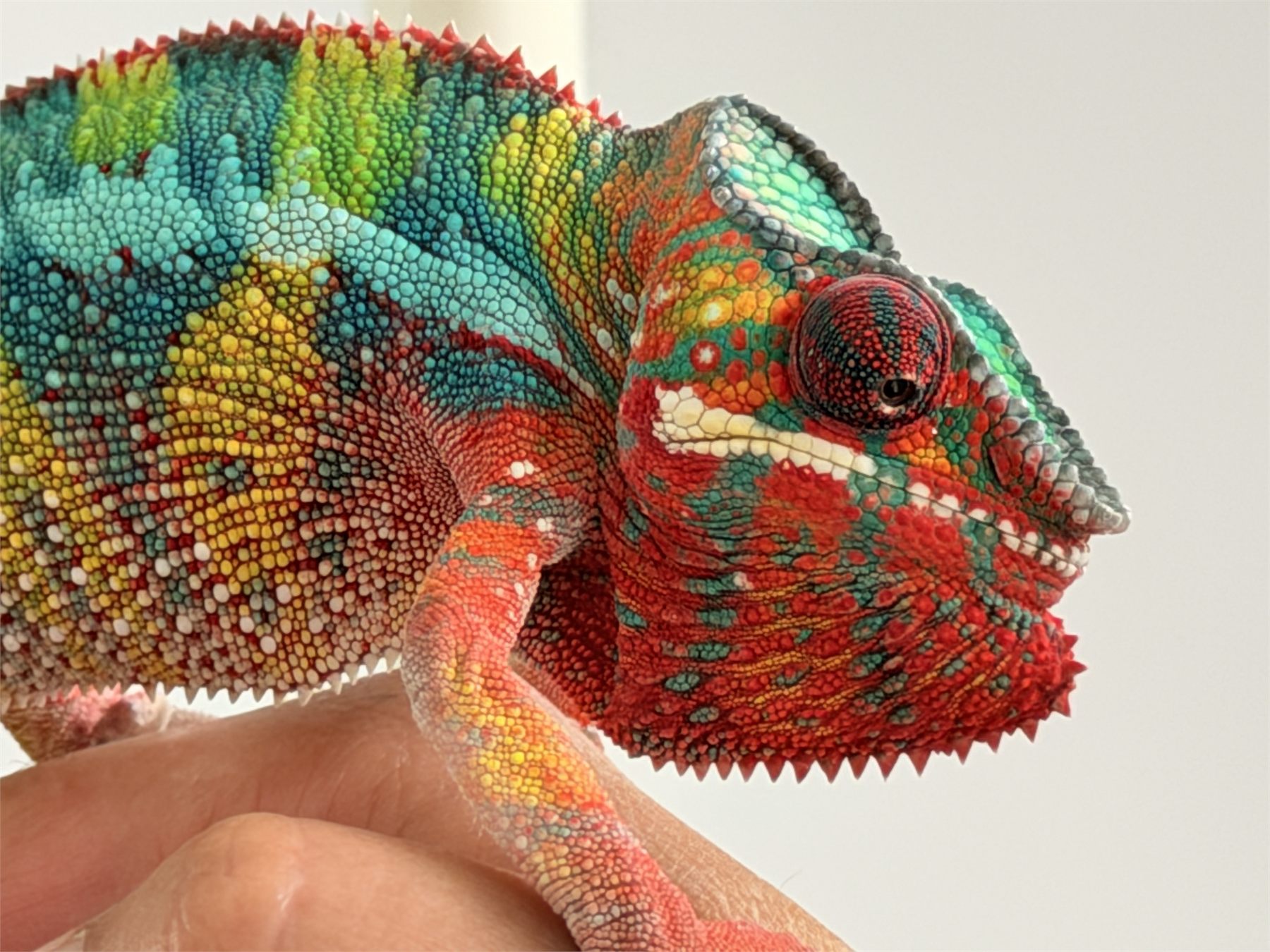
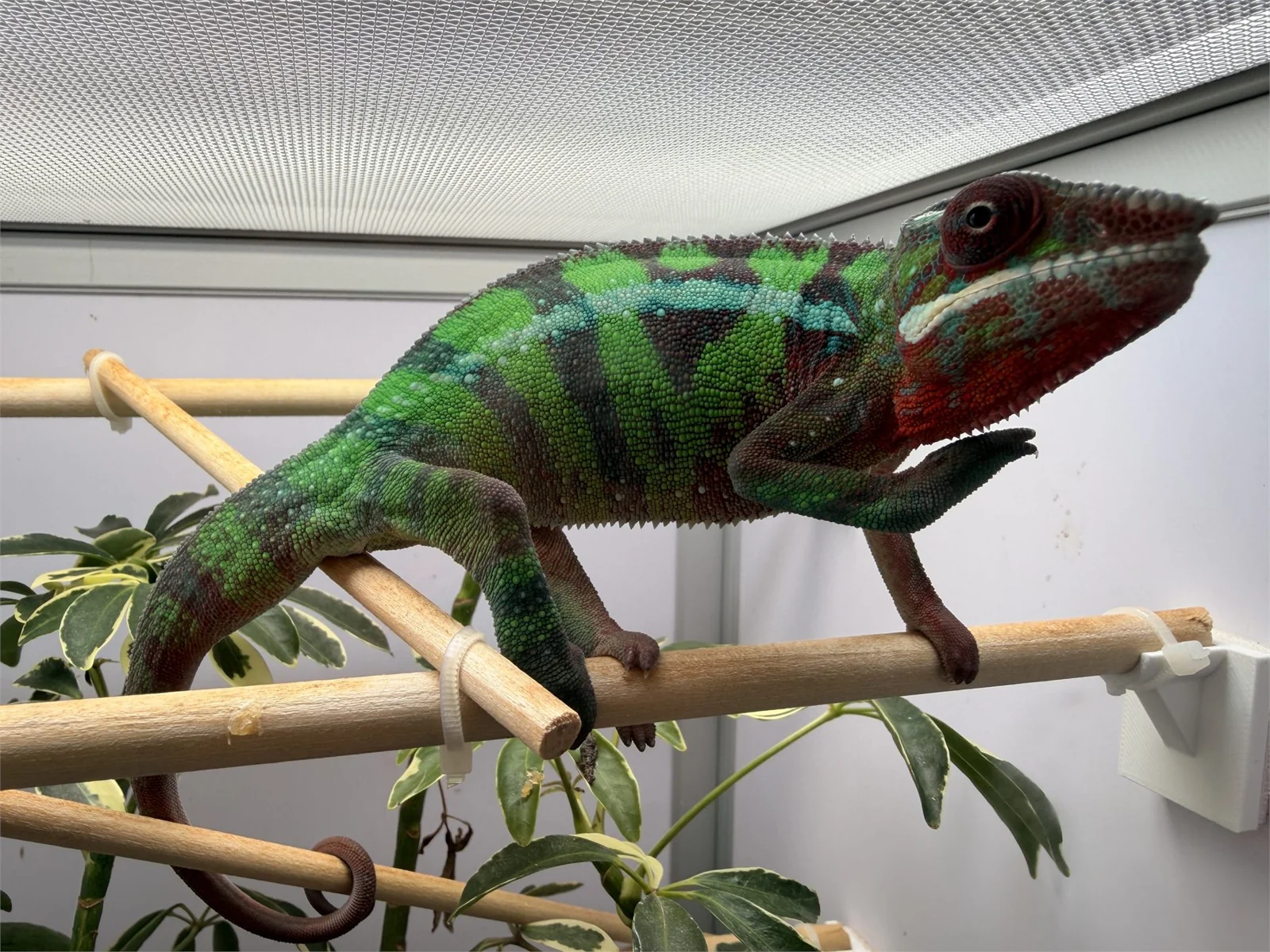
What a Healthy Chameleon Looks Like
- Full, rounded eye turrets that rotate actively and independently
- A strong grip: they should hold a branch confidently
- Alert, responsive behavior: tracking movement, hunting readily
- Bright colors during the day, darkening only to bask
- Clean, clear nostrils and mouth with no discharge or bubbling
- Steady weight gain when young; a stable weight when mature
- Urates that are moist rather than dry and chalky
- Straight limbs with no bowing or swelling at the joints
Weigh your chameleon weekly and write it down. Weight trends are the earliest objective signal you get that something is going wrong, long before behavior changes.
Reading Color
Color change is communication and thermoregulation, not camouflage. Learning to read it is how you learn to read your animal.
- Bright, saturated color: alert, healthy, comfortable. Males display hardest when showing off.
- Dark, almost black: usually thermoregulation, absorbing heat while basking, and normal first thing in the morning. If it persists all day at correct temperatures, read it as a sign of high stress and start looking for the cause.
- Pale, washed out: often just relaxed or asleep. Sleeping chameleons go very pale, and that is fine.
- High contrast, sharp patterning: stress or a threat display, especially with a flattened body and an open mouth.
- Females showing receptive or gravid coloration: learn what your individual looks like in each state; it varies.
Learn Your Individual
Every chameleon has its own baseline. This is precisely why we raise ours individually. We know each animal's normal color, appetite and behavior, and we tell you about it when you take one home. You should get to know yours the same way.
Common Health Problems
Metabolic Bone Disease (MBD)
Caused by insufficient UVB, poor calcium supplementation, or both. Signs include a rubbery jaw, bowed limbs, weak grip, tremors and reluctance to climb. Entirely preventable. Caught early it can be stopped, but bone that has already deformed does not straighten out again, so this is one to get right rather than fix. See our lighting guide.
Respiratory Infection
Signs: open-mouth breathing when not hot, popping or clicking sounds, bubbles or mucus at the nose or mouth, lethargy, and a chameleon that sits with its head raised. Usually caused by prolonged warm damp conditions with poor ventilation. Needs a vet: these do not resolve on their own.
Dehydration
Sunken eyes, lethargy, stuck shed, and urates that are both discolored and dry and chalky. Color alone is not the signal; some orange is normal. See the hydration guide.
Mouth Rot (Stomatitis)
Swelling around the mouth, discolored or cheesy material along the gum line, reluctance to eat. Often follows an injury or an underlying stressor. Requires veterinary treatment.
Eye Problems
Chameleons clean their eyes by rotating and bulging the turret. Persistent closing of one eye, swelling, or discharge suggests debris, an infection or a vitamin A deficiency. A chameleon keeping an eye closed during the day always warrants attention.
Thermal Burns
Usually on the casque or upper back, from a basking bulb mounted too close. Presents as discolored, crusted or blistered skin. Move the bulb immediately and see a vet if the skin is broken.
Parasites
Captive-bred animals in clean conditions rarely carry heavy parasite loads, but it happens. Signs are weight loss despite good appetite, and loose or unusual droppings. A fecal test at an exotics vet settles it quickly and cheaply.
Shedding
Chameleons shed in patches rather than in one piece. The skin goes dull and whitish, then flakes away over a few days. Young animals shed frequently, every few weeks, and adults every couple of months.
- Never peel shedding skin off. You will damage the new skin underneath.
- Do not drop the humidity during a shed. Whatever else is true, a shedding chameleon needs its hydration.
- Watch toes and the tail tip: retained shed there can constrict and cause the loss of a digit or tail tip
- For a stubborn piece, a moistened cotton bud and patience. If it will not come away, that is a vet job, not a stronger tug.
- Expect reduced appetite and a grumpier animal for a day or two. Normal.
Females and Egg Laying
Female panther chameleons lay eggs whether or not they have ever met a male. Infertile clutches are normal, and you must be prepared for them.
- Have a lay bin in place from sexual maturity onward, before she shows any sign of needing it: a container with roughly 4–6 in of slightly damp play sand, or a sand and soil mix, that holds the shape of a tunnel without collapsing
- Keep her feeding restrained between clutches; overfeeding drives bigger and more frequent ones. Once she is gravid, feed her properly: see the feeding guide.
- A gravid female becomes restless and starts digging exploratory holes
- Give her privacy while she lays. Being disturbed can cause her to abandon the site and retain the eggs.
Getting the Lay Bin Right
Put it in before she needs it. A female coming into lay gets restless and starts investigating the floor and digging test holes. If you can read that reliably you can time it yourself, and we do. But if this is your first female you may not spot it in time, and the cost of missing it is severe: a female who cannot find anywhere acceptable to dig will hold her eggs. Have the site there from the moment she is mature, so recognizing the behavior is a bonus rather than a requirement.
Experienced keepers who are confident reading the signs often do time it themselves and put the bin in as she comes into lay. That is a reasonable way to work once you have seen it a few times. It is not the way to learn.
Then keep it clean rather than taking it out. Damp substrate sitting in a warm enclosure does go stale, and a bin you set up once and forget becomes a genuine bacterial problem. The answer is maintenance, not absence: pick waste out of it when you see any, and change the substrate every month or two, sooner if it gets fouled.
Does the bioactive floor count as a laying site? Usually not, and not as we have described building one. Our enclosure guide puts three to four inches of substrate over a drainage layer of clay balls. That is shallower than she wants, and when she digs down she reaches loose drainage media that collapses rather than the firm bottom she is looking for. Give her a separate bin unless your floor is genuinely deep enough, holds a tunnel without caving, and sits on something solid.
You will also see very deep bins recommended, often twelve inches or more. We have moved away from that. A female is not trying to tunnel as deep as she can; she is digging until she reaches a firm bottom, and then laying above it. Give her a foot of loose substrate and you are asking an already exhausted gravid animal to keep digging for no benefit.
What she actually needs is four to six inches of substrate that is damp enough to hold a tunnel without caving in, a solid floor underneath it, and to be left alone. Consistency and privacy matter far more than depth. Squeeze a handful: it should clump and hold together, not crumble apart or drip.
Egg Binding Is an Emergency
If a female is visibly gravid, has been digging, and then stops trying, becomes lethargic or strains without producing eggs, she may be egg bound. This is life-threatening and needs an exotics vet immediately, not in the morning.
When to See a Vet
Find an exotics vet who sees chameleons before you need one. Phone around, confirm they treat reptiles, and save the number. Do not start that search during an emergency.
Go straight in for:
- Open-mouth breathing, clicking, or any nasal or oral discharge
- A rubbery jaw, bowed limbs, tremors or an inability to grip
- An eye held closed for more than a day
- Refusing food for more than a few days alongside lethargy
- Any suspicion of egg binding
- Sudden weight loss
- Prolapse of any kind, which is always an emergency
Chameleons mask illness extremely well. By the time an animal looks obviously unwell, it has usually been unwell for a while. Act on early signals rather than waiting.
Handling
Here is the honest version: chameleons do not enjoy being handled. They are not social animals and they do not seek out contact. At best, a well-adjusted chameleon tolerates it calmly.
That does not mean never touch them. It means handle on their terms:
- Let them walk to you. Offer a flat hand as a bridge rather than grabbing from above.
- Never grab from above. That is exactly what a predatory bird does.
- Keep it short. A few minutes is plenty.
- Watch for stress signals: darkening, flattening, gaping, hissing, rocking. Put them back.
- Support the whole body. Never hold by the tail or a limb.
- Wash your hands before and after, every time.
Many keepers find the most rewarding relationship is a chameleon that reliably comes to the front of the enclosure when you approach, takes a feeder from your hand, and steps onto it willingly. That is a genuinely trusting animal, and it is built by being predictable and unthreatening over months, not by handling more often.
The First Week Home
The move to your house is the most stressful thing that has happened to this animal. How you handle the first week sets the tone for everything after.
- No handling at all for seven days. None.
- Mist and feed on a normal schedule and otherwise leave them alone
- Expect them to be dark, hidden and uninterested in food for the first day or two
- Keep other pets away from the enclosure. A chameleon should not live in a high traffic part of the house at all: pick a calm room, not the hallway or the living room sofa wall.
- Resist the urge to check on them constantly: a face at the glass every ten minutes is a predator, as far as they are concerned
If your chameleon has not eaten by day four or five, message us. Some settling refusal is normal; a persistent refusal is worth talking through.
Sources for This Guide
The specific articles behind the recommendations on this page. We have read them, and if you want to go further than this guide takes you, they are where to go next.
- Chameleon Medical: Shedding, Bill Strand, Chameleon Academy
- Chameleon Medical: Respiratory Infection, Bill Strand, Chameleon Academy
- Caring for Egg-Laying Female Chameleons, Bill Strand, Chameleon Academy